The Eagle Costa Rica Lost, and How We Bring It Home
By Miguel Guevara, Founder of Grow Jungles
Key Insights
- •The Harpy eagles seen in Costa Rica in recent years were most likely visitors from Nicaragua. As far as we know, no pair nests here today.
- •Panama and Belize released 49 Harpy eagles between 1998 and 2009. Their results tell us what a Costa Rican return would need.
- •The Osa Peninsula, linked to La Amistad by official biological corridors, may be the strongest place in the country to try.
Part 1 of our Harpy eagle series
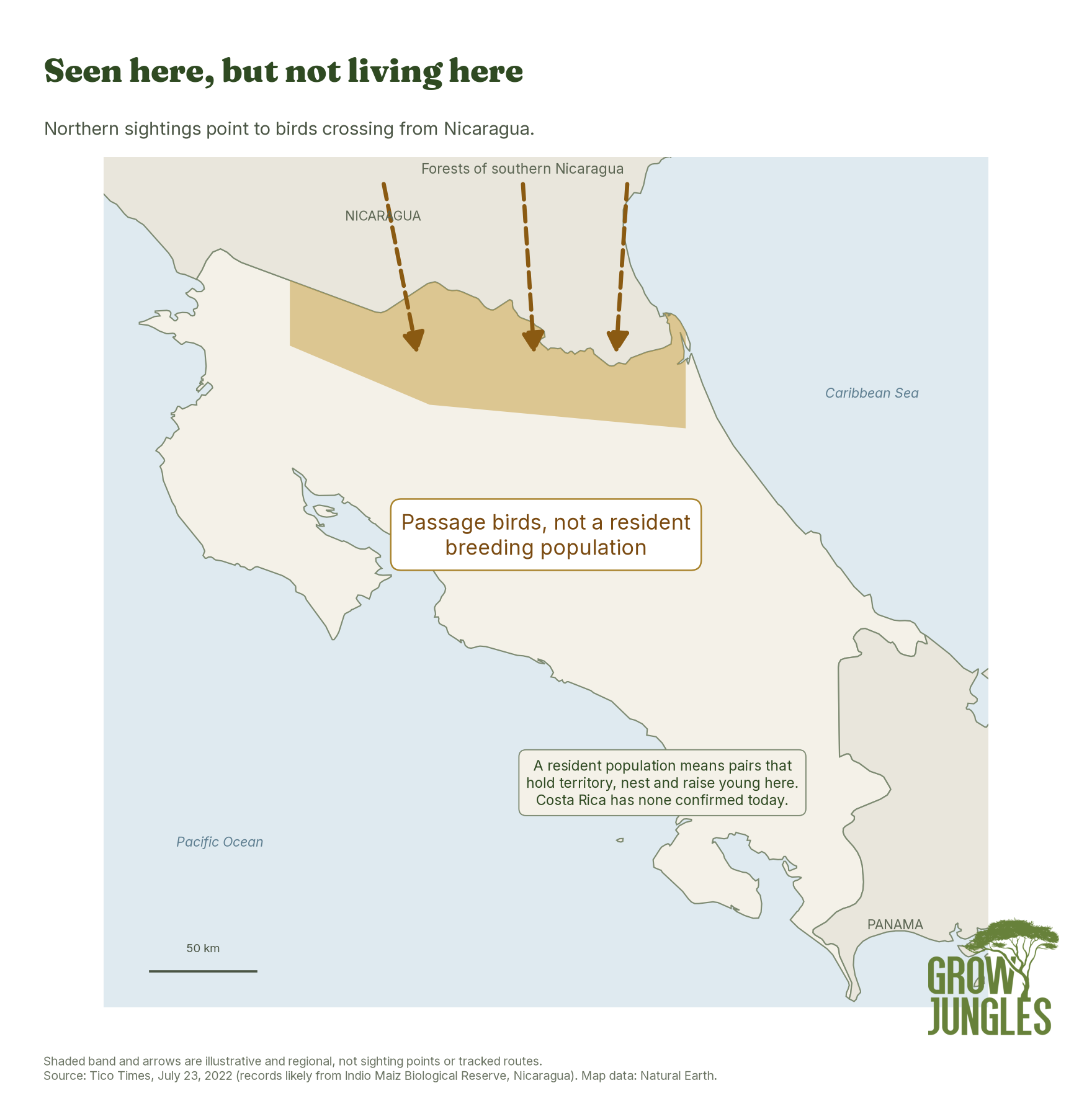
Map of the Osa Peninsula and La Amistad with the corridors that link them. Seen here, but not living here
In January 2020, the ecologist Andrew Whitworth crouched in the leaf litter of the Osa Peninsula and pulled out the skull of a spider monkey. Three holes went through the top of the cranium and a fourth through the base. He was sure a Harpy eagle had killed it. The trouble, as he later wrote, was that nobody had photographed a Harpy on the Osa in almost twenty years [1].
We think about that skull a lot. Our camera traps in southern Costa Rica have filmed jaguars, pumas and tapirs since 2021. The eagle has never shown up.
The Harpy has been in the stories of this isthmus far longer than in our field notes. Among the Bribri of Talamanca, Sibö, the creator, often takes the form of a kite or a buzzard, and in old Talamancan art human figures appear in the grasp of raptor beaks [2]. In Panama's Darién, the Emberá community of Playa Muerto brought back an old Eagle Dance after a Harpy nest was found near the village and visitors started coming to see it [3]. Costa Rica's own forests have gone quiet on this bird. We want to change that.
Seen here, but not living here. Harpy eagles have turned up in Costa Rica in recent years, including in the far north close to the Nicaragua border. A biodiversity specialist interviewed by the Tico Times said those records probably come from the Indio Maíz Biological Reserve in Nicaragua [4]. As far as we know, no resident pair holds a territory or raises a chick in Costa Rica today.
Why the harpy vanished
This is the short version. For more history, read our earlier piece, The Extinction of the Harpy Eagle in Costa Rica.
Forest went first. Costa Rica's forest cover fell from about 70% of the country in 1950 to roughly 20% by 1987, one of the fastest rates of loss in Latin America [5]. A bird that nests in giant emergent trees and hunts sloths and monkeys through an unbroken canopy had less and less room. Guns did the rest. People shot harpies out of fear or curiosity, even though a three-year study of five Amazon nests found that sloths made up 78% of prey and turned up no livestock or pets at all [6]. The IUCN Red List, in its 2021 assessment, lists the species as Vulnerable and declining [7].
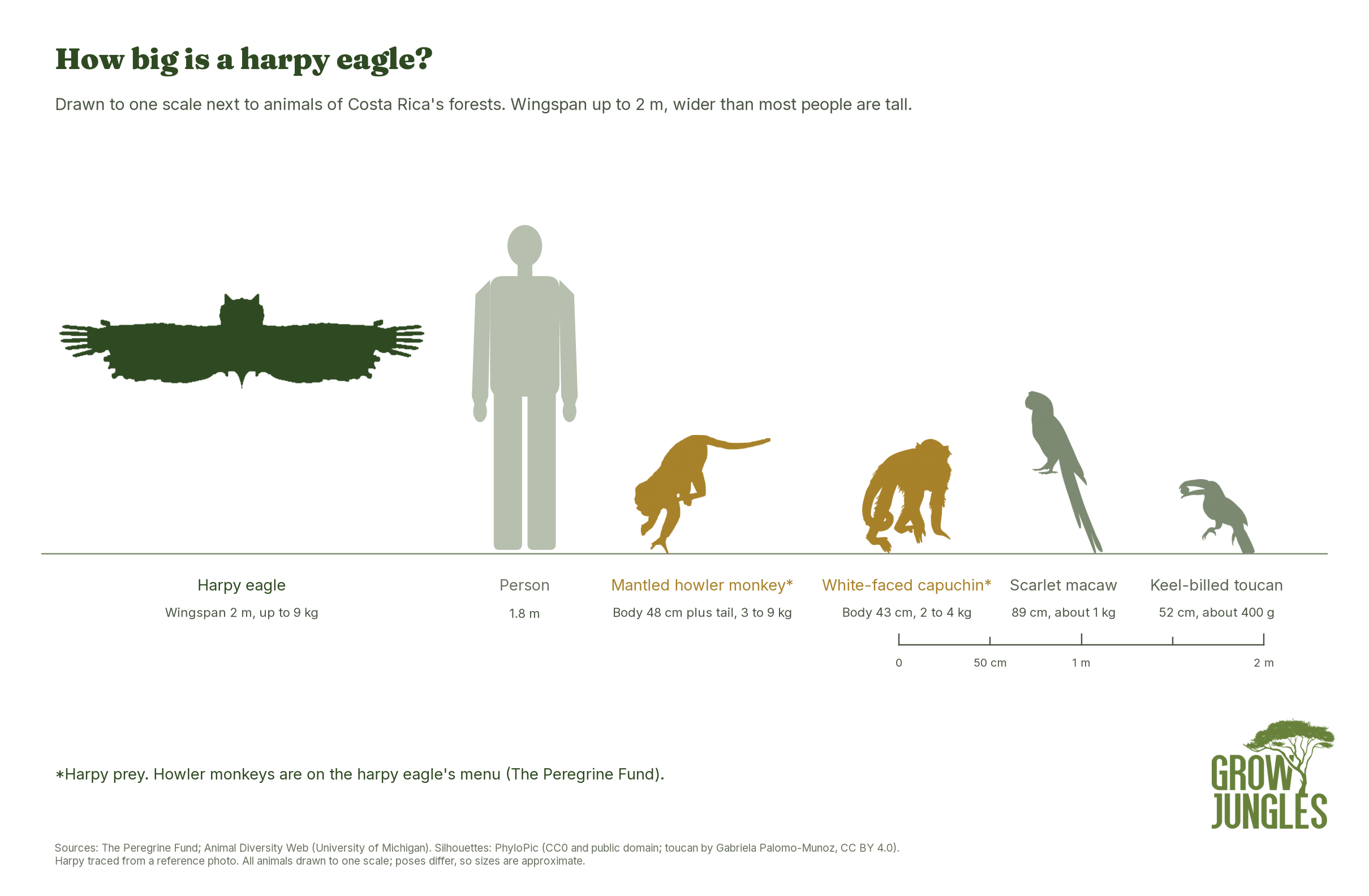
Size comparison drawn to one scale: a harpy eagle with wings spread beside a person, a howler monkey, a capuchin monkey, a scarlet macaw and a keel-billed toucan
A harpy eagle next to a person and some of Costa Rica's best known animals, drawn to the same scale.
Today the bird is close to gone from Costa Rica. In July 2022 one was filmed in the Maquenque Mixed Wildlife Refuge at Boca Tapada, in the northern lowlands. It was the first record in the country since 2017, when one was documented near Upala, also in the north [4]. Whitworth, writing in Mongabay, called the 2022 bird likely a wanderer from Indio Maíz, just across the border, and said it did not mean harpies had recolonized Costa Rica [1].
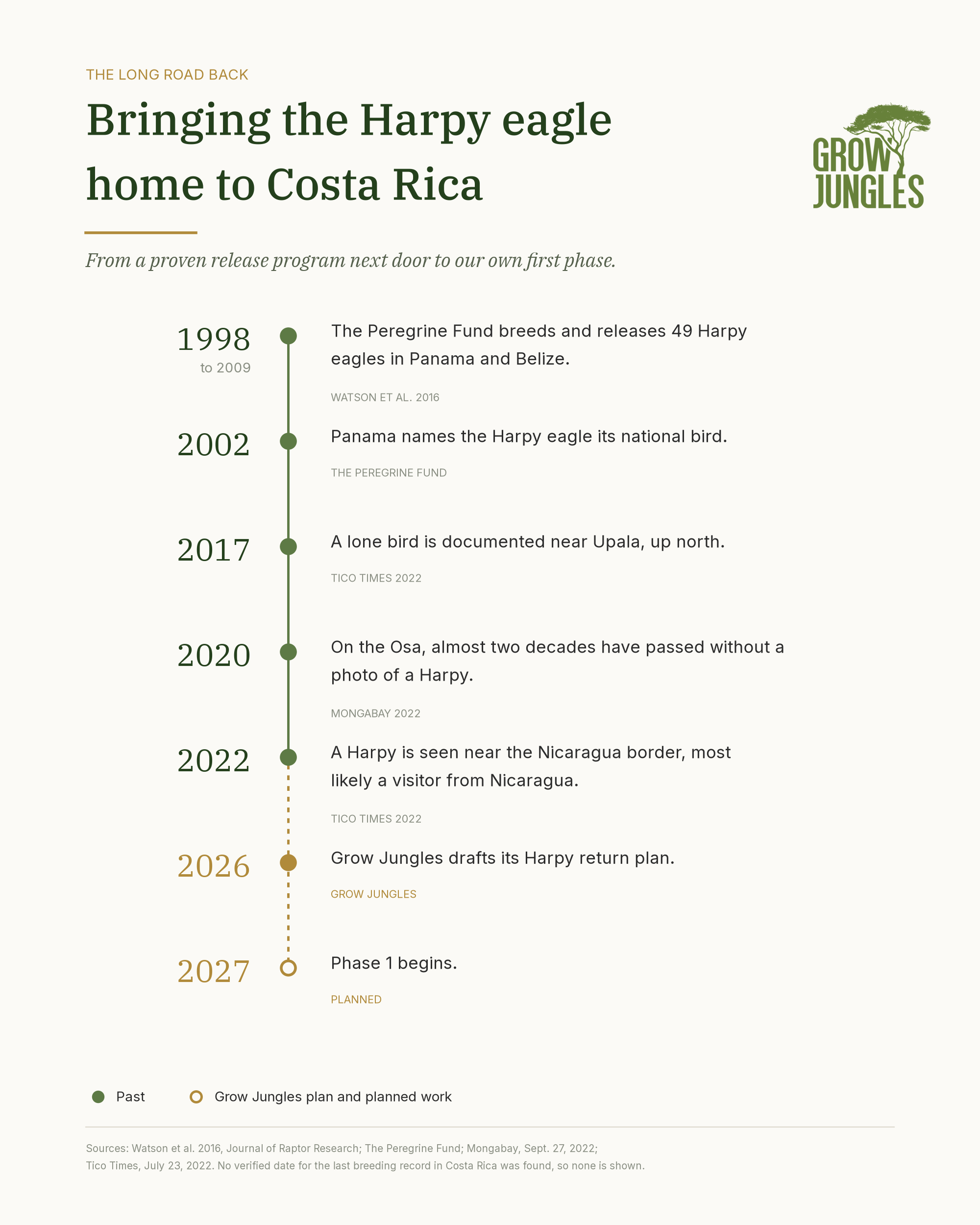
Timeline of the harpy eagle in Costa Rica, from forest loss to recent sightings and recovery
The long road back. Dates from the sources listed below; 2026 and 2027 are our own plan.
Why now
The forest came back. Cover has climbed back to around 52% of Costa Rica's land, helped by national parks and the country's payments to landowners who keep forest standing [5]. The Osa now has over 80% forest cover, four protected areas and, in Whitworth's words, a "bountiful prey base" for the eagle [1].
We also know a return can be done, because our neighbors tried it. The Peregrine Fund bred Harpy eagles in captivity, first in Idaho and then in Panama, and released 49 birds in Panama and Belize from 1998 through 2009 [8]. Panama declared the Harpy its national bird in 2002 [9]. Some releases took place in La Amistad International Park on the Panama side of the border [10], the same mountain forest that runs north into Costa Rica's Talamanca range, a UNESCO World Heritage site the two countries share [11].
Waiting will not work. A lone bird drifting down from Nicaragua every few years cannot start a population.
What it takes
The Panama and Belize work left us a frank record. When the last radio-tagged bird died in 2011, 63% of released eagles were known or presumed dead, 31% were missing and possibly alive, and 6% were back in captivity. Shooting caused 44% of known deaths. The researchers found that birds released close to the age when they would naturally leave their parents did best, and that stopping persecution and protecting forest mattered most [8]. Those lessons shape every step of our plan.
The first step is a feasibility study, as the IUCN guidelines on reintroductions recommend: habitat, prey, threats and what local people think, before any bird moves [12]. After that come permits through SINAC, Costa Rica's national system of conservation areas. Then a captive breeding pair held under permit with experienced partners, flight aviaries, keepers and a vet, GPS satellite tags for every released bird, and camera traps to watch the prey base.
Our working estimate for Phase 1 in 2027 is $444,000 to $633,000. That is our own estimate, built from comparable costs, and we will refine it as partners, permits and real quotes come in. Grow Jungles does not own land. Any facility land would be leased.
Why the Osa, and how eagles would use the corridors
Young released harpies travel. The Peregrine Fund tracked 36 of its released eagles in Belize and Panama. They dispersed an average of 29.4 km from where they were let go, and their yearly home ranges averaged about 1,040 square kilometers. Nine birds released in Belize ended up using Guatemala or Mexico as well [10]. The authors recommend release areas with a buffer of about 30 km of well-connected forest, and warn that efforts may fail unless neighboring countries work together [10].
That is a big ask for any single park, and it is where the Osa stands out. The peninsula already has the forest and the prey. It is also tied to the mountains by two official corridors in Costa Rica's National Biological Corridors Program. The AmistOsa Biological Corridor, about 92,900 hectares across Coto Brus, Golfito, Corredores and Buenos Aires, was created to reconnect La Amistad International Park with Piedras Blancas National Park and the Golfito wildlife refuge [13]. The Paso de la Danta Biological Corridor runs along the Fila Costeña, the coastal range, and aims to link the forests of the Osa and Golfo Dulce with the Los Santos Forest Reserve in the Talamanca range [14][16]. Costa Rica has 44 official corridors, covering about a third of the country [15].
Put together, the Osa sits at one end of a forest chain that climbs into Talamanca and crosses into Panama's half of La Amistad, where harpies have been released before. An eagle born of this project could, in principle, follow that chain and meet birds from the Panama side. The goal is one connected population across a shared forest.
We will never publish where an eagle, a nest or any other wild animal is. Any maps we share will be regional and clearly marked as illustrations.
Coming in Part 2
Next we look at what a returning eagle could mean for the people of southern Costa Rica: birding visitors, guide work, local jobs and campesino families who keep the forest standing.
The feasibility study is where this all starts. If you want to help it happen, give at donorbox.org/grow-jungles.
References & Source Notes
- Whitworth, A. (2022, Sept. 27). Harpy eagle's return to Costa Rica means rewilding's time has come (commentary). Mongabay. https://news.mongabay.com/2022/09/harpy-eagles-return-to-costa-rica-means-rewildings-time-has-come-commentary/
- Bribri mythology. Exhibiting Historical Art, University of Southern California (Scalar). https://scalar.usc.edu/works/exhibiting-historical-art/bribri-mythology
- Aguilucho: Dance of the Harpy Eagle (film). Films for the Forest, with the Emberá of Playa Muerto and The Peregrine Fund. https://www.filmsfortheforest.org/films/aguilucho-dance-of-the-harpy-eagle
- Fernández, I. (2022, July 23). First Harpy Eagle sighting in Costa Rica since 2017. The Tico Times. https://ticotimes.net/2022/07/23/first-harpy-eagle-sighting-in-costa-rica-since-2017
- Porras, I. et al. (2013). Learning from 20 years of Payments for Ecosystem Services in Costa Rica. IIED. https://www.iied.org/sites/default/files/pdfs/migrate/16514IIED.pdf
- Aguiar-Silva, F.H., Sanaiotti, T.M. and Luz, B.B. (2014). Food habits of the Harpy Eagle, a top predator from the Amazonian rainforest canopy. Journal of Raptor Research 48(1): 24 to 35. https://doi.org/10.3356/JRR-13-00017.1
- BirdLife International (2021). Harpia harpyja. The IUCN Red List of Threatened Species. https://www.iucnredlist.org/species/22695998/197957213
- Watson, R.T., McClure, C.J.W., Vargas, F.H. and Jenny, J.P. (2016). Trial restoration of the Harpy Eagle in Panama and Belize. Journal of Raptor Research 50(1): 3 to 22. https://assets.peregrinefund.org/docs/research-library/published-research/trial-restoration-of-the-harpy-eagle-a-large-long-lived-tropical-forest-raptor-in-panama-and-belize-2017-02-08_093306.pdf
- The Peregrine Fund. Harpy Eagle. https://peregrinefund.org/explore-raptors-species/eagles/harpy-eagle
- Naveda-Rodríguez, A. et al. (2022). Dispersal and space use of captive-reared and wild-rehabilitated Harpy Eagles released in Central American landscapes. Diversity 14(10): 886. https://www.mdpi.com/1424-2818/14/10/886
- UNESCO World Heritage Centre. Talamanca Range-La Amistad Reserves / La Amistad National Park. https://whc.unesco.org/en/list/205
- IUCN/SSC (2013). Guidelines for Reintroductions and Other Conservation Translocations. https://portals.iucn.org/library/node/10386
- Plan de Gestión del Corredor Biológico AmistOsa (2018), Áreas de Conservación Osa and La Amistad Pacífico, published on Costa Rica's national biodiversity strategy site. https://enbcr.go.cr/sites/default/files/plan_de_gestion_cb_amistosa_2018_final.pdf
- Programa Nacional de Corredores Biológicos. Corredor Biológico Paso de la Danta. https://biocorredores.org/corredoresbiologicos/corredores-biologicos/corredor-biologico-paso-de-la-danta
- Programa Nacional de Corredores Biológicos. ¿Qué es el PNCB? https://biocorredores.org/corredoresbiologicos/programa-nacional-de-corredores-biologicos
- ASANA. Plan de Gestión, Corredor Biológico Paso de la Danta. https://www.asanacr.org/wp-content/uploads/2021/06/Plan-de-Gestion_DANTA-1.pdf
Note on sources: the Phase 1 cost range is a Grow Jungles estimate, not a quote. Maps and timelines are regional illustrations, not tracking or sighting data.
You Might Also Like
More stories on similar topics
Share this story
Related Stories

In the Footsteps of the Jaguar: A Journey into the Heart of Jaguar Territory
Artist Tico Haroutiounian's obsession with the elusive melanistic jaguar led him deep into the rainforests of the Osa Peninsula, where patience, danger, and determination culminated in a breathtaking face-to-face encounter with the wild.
The Extinction of the Harpy Eagle (Harpia harpyia) in Costa Rica
As deforestation escalates and hunting pressures increase, the magnificent Harpy Eagle faces extinction in Central America. Discover how organizations like the Peregrine Fund are working to save this incredible species.
The Extinction of the Giant Anteater (Myrmecophaga tridactyla) in Costa Rica
The giant anteater faces extinction in Costa Rica due to habitat loss, fires, poaching, and roadkill. Discover why this unique creature is vulnerable and what conservation efforts are underway to save it.