
Jaguars in Texas? The Forgotten History and Wild Future of America's Apex Predator
By Miguel Guevara, Founder of Grow Jungles
Key Insights
- •Jaguars historically roamed Texas, and understanding their past can inform future conservation efforts. Engage in public education campaigns to raise awareness about the historical presence of jaguars and their importance to local ecosystems.
- •The cultural significance of jaguars among Indigenous peoples highlights the need for culturally sensitive approaches to conservation. Collaborate with Indigenous communities to integrate their knowledge and perspectives into jaguar rewilding initiatives.
- •Historical records indicate that jaguar populations can return if appropriate habitats are preserved and protected. Advocate for land conservation strategies that maintain and restore the diverse ecosystems where jaguars could thrive.
Will Jaguars Return to Texas?
History, Sightings & Rewilding Plans
In the dense brushlands of South Texas, among the thorny mesquite, cactus patches, and winding creeks, a ghost moves silently. With golden eyes and a rosette-covered coat, the jaguar (Panthera onca) is not only the largest cat in the Americas but also one of its most elusive. While today jaguars are more commonly associated with the Amazon Basin or the jungles of Central America, their historical range once extended deep into the southwestern United States, including Arizona, New Mexico, and yes—Texas.
For centuries, jaguars roamed freely across the Lone Star State. But their presence today is more myth than reality, and their future hinges on whether humans will allow them to reclaim a land that was once theirs.
A Forgotten Native — Jaguars in Texas History
The story of jaguars in Texas is one of memory, disappearance, and potential rebirth. Historical records and accounts from settlers, ranchers, and naturalists confirm that jaguars were once found as far east as Louisiana and as far north as the Grand Canyon. In Texas, they were documented as early as the 1800s.
One of the earliest recorded jaguar killings in Texas occurred in 1825 near the Nueces River in what is now Nueces County. The area, characterized by a mix of prairie and dense brush, was ideal jaguar habitat. Between 1850 and 1900, accounts of jaguar sightings and killings became more common, particularly in South Texas. Counties like Duval, Brooks, Kenedy, and Starr recorded multiple instances of jaguar activity.
In 1903, naturalist Vernon Bailey documented a jaguar specimen in Cameron County near Brownsville. That same year, a rancher reported killing a large male near the Rio Grande. These reports were not isolated.
But the tide was turning.
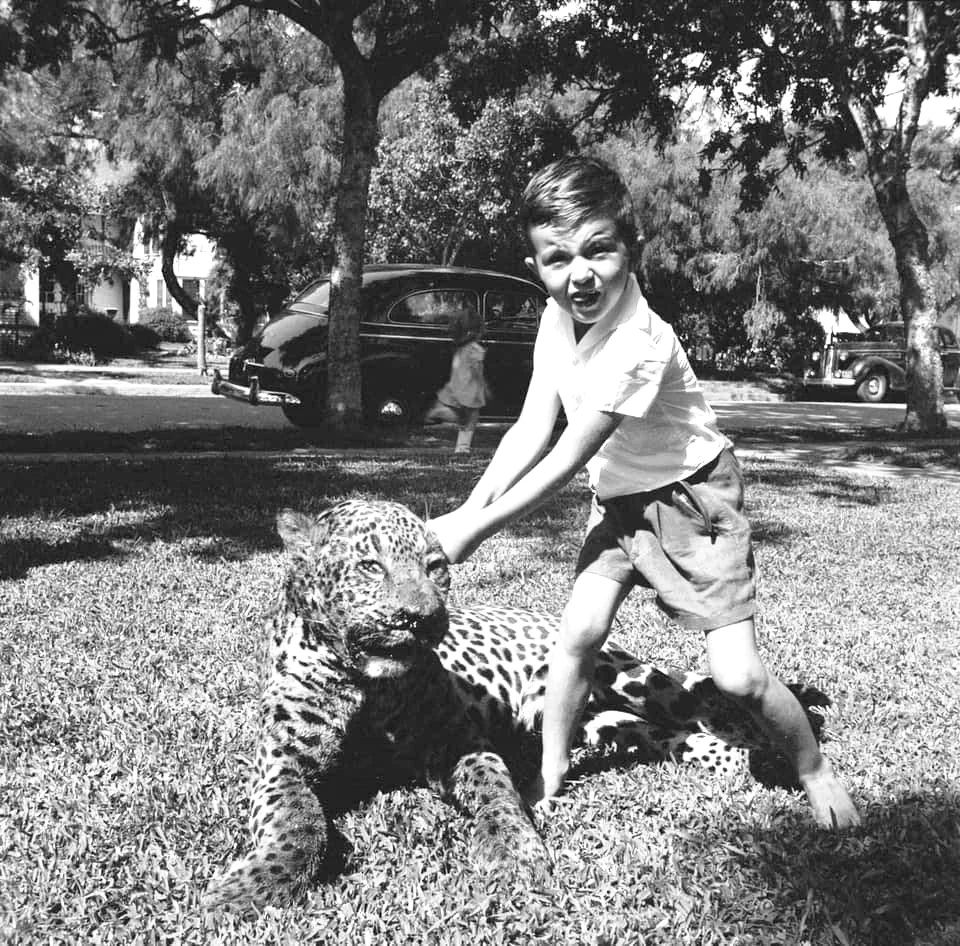
Historical photo: Child with young jaguar in captivity, early 1900s
El Tigre and the People: Indigenous Memory of the Jaguar
Long before Spanish missionaries recorded jaguar sightings along the Nueces River, the peoples of South Texas and northeastern Mexico had lived alongside these cats for thousands of years. The Coahuiltecan-speaking groups who occupied the brushlands of the Lower Rio Grande Valley — hundreds of small, autonomous bands whose territories overlapped directly with the jaguar's range — knew this animal intimately.[1]
Across the broader Southwest and into Mesoamerica, the jaguar carried immense cultural weight. The Mimbres, Hohokam, and Anasazi peoples all produced artwork that almost certainly depicts jaguars. In New Mexico's Pottery Mound site, an Anasazi mural features what scholars call a well-drawn and unmistakable rendering of the big cat. Among the Pueblo peoples, the mythical rohona — a powerful and sacred animal — is believed to have been the jaguar. Some Apache groups recognized a potent form of jaguar medicine, and quivers made of jaguar skin were prized by several southwestern tribes.[2]
In Mesoamerican cultures directly connected to the peoples of Texas and Tamaulipas, the jaguar was not merely wildlife — it was a deity. All major pre-Columbian civilizations of Mexico, including the Olmec, Maya, and Aztec, featured a jaguar god in their religious practice. The Aztec warrior class's highest order was known as the Jaguar Warriors. For the Maya, the jaguar represented the power to move between the living world and the spirit world — a being equally at home in day and night.[3]
This is not incidental history. The Tohono O'odham Nation's naming of modern-day Arizona jaguars — one was given the name O:ṣhad Ñu:kudam, meaning 'jaguar protector' in the O'odham language — reflects a living cultural relationship that has survived even the animal's physical absence. Many Indigenous communities in the Southwest have deep ties to jaguars embedded in their languages, ceremonies, and worldviews.[4]
When we speak of returning the jaguar to Texas, we are not proposing something entirely new. For the Coahuiltecan and the many peoples of the Rio Grande borderlands, the jaguar's presence was simply the natural order of the world.
Extermination and Disappearance
By the 1940s, jaguar populations across the United States were in sharp decline. Habitat destruction, hunting for pelts, and federal predator control programs decimated the species.[5] In Texas, ranchers—concerned with livestock safety—often shot big cats on sight.
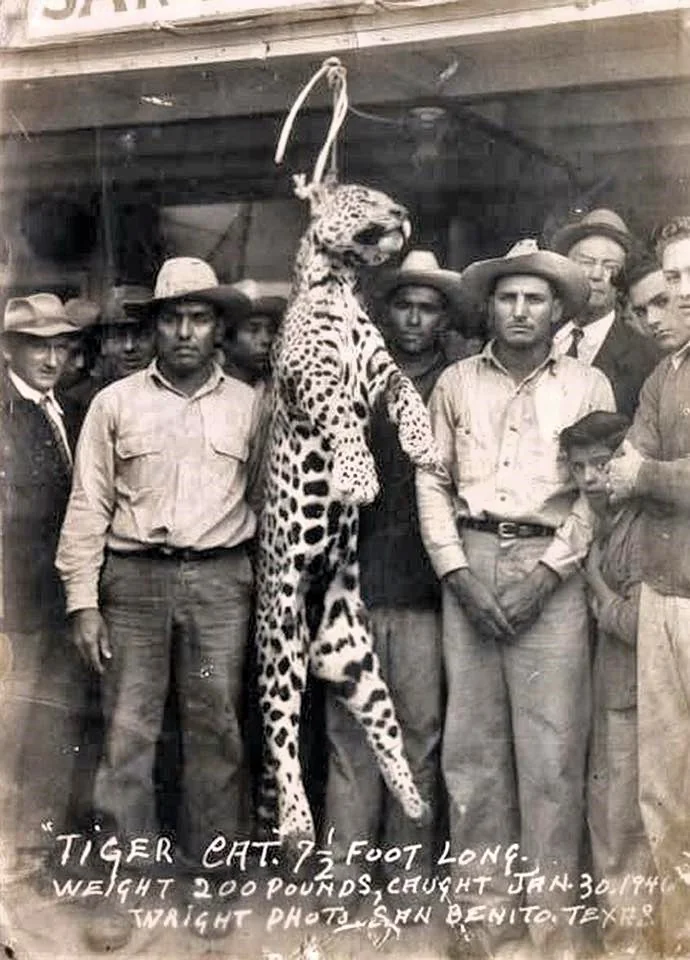
Historic record: Large male jaguar killed near Benito, Texas, January 30, 1946. Weight 200 pounds.
The last confirmed jaguar in Texas was killed in 1948 near Kingsville, Kenedy County.[6] The surrounding region is part of the South Texas Brush Country, once teeming with wildlife, from ocelots to black bears to jaguars. The cat — a small male weighing 121 pounds according to contemporaneous newspaper records — was killed by a farmhand and its story preserved in the Corpus Christi Caller-Times. After 1948, jaguars were considered extirpated from the state.
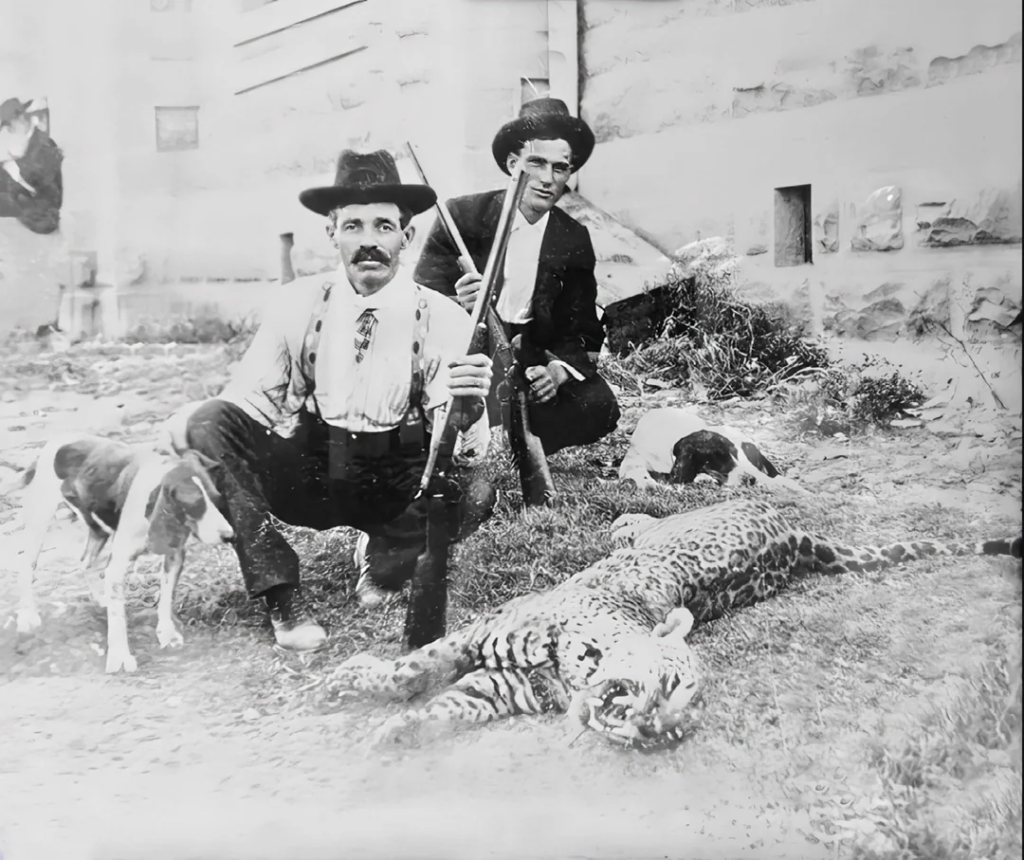
Hunters with killed jaguar, early 1900s South Texas
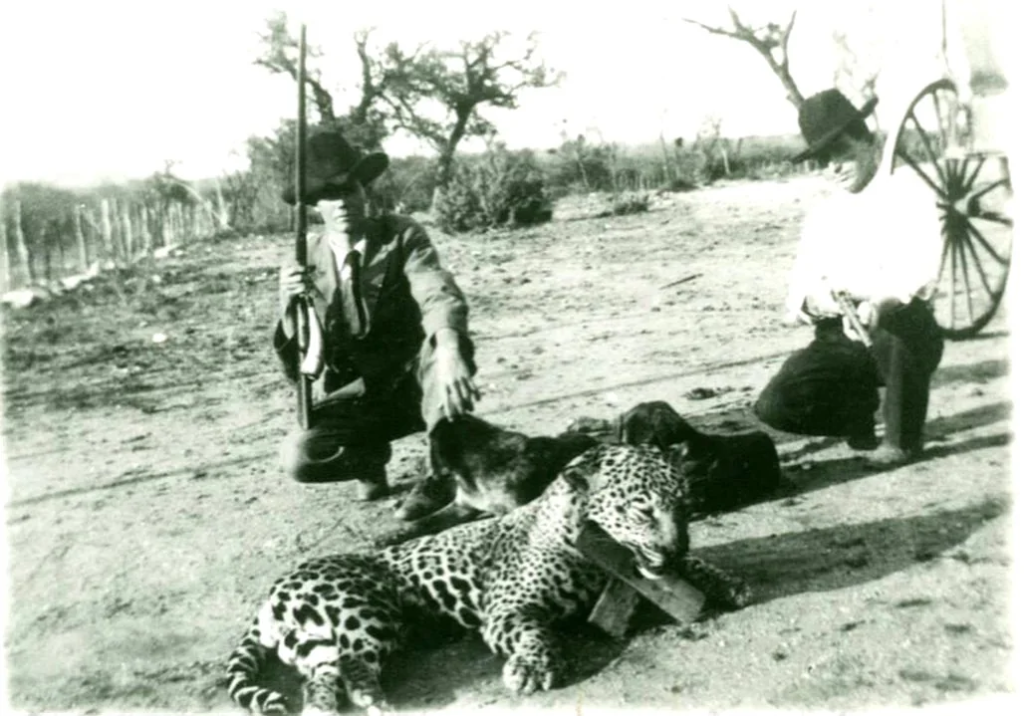
Rancher and jaguar carcass in South Texas landscape, historical archive
Borderlands and the Modern Jaguar
Across the border, however, jaguars continued to persist. Northern Mexico — especially the Sierra Madre Occidental and the subtropical forests of Sonora and Tamaulipas — remained a jaguar stronghold.[7]
In the 1990s, conservationists in Mexico began to track jaguars using camera traps and telemetry. They discovered that some male jaguars were still dispersing north, sometimes covering over 100 miles in search of territory and mates.[7] In 1996, a male jaguar named "Macho B" was photographed in southern Arizona, just 60 miles from the Texas border.[8] He would become a symbol of the species' tenacity, living in the Arizona mountains for 13 years before being euthanized due to health complications in 2009.[9]
While Arizona gained national attention for its jaguar sightings, Texas remained silent. But biologists were watching closely.
The Ocelot: A Preview of What Jaguar Recovery Might Look Like
If you want to understand what jaguar recovery in Texas might look like — its promise, its obstacles, and its fragility — look first at the ocelot.
The ocelot (Leopardus pardalis) is South Texas's other spotted cat, and it shares virtually identical habitat preferences with the jaguar: dense Tamaulipan thornscrub, access to water, large undisturbed ranchlands, and minimal human encroachment. Once ranging across Louisiana, Arkansas, and much of Texas, fewer than 100 ocelots remain in the entire United States today — all of them in South Texas, split between two isolated populations.[10]
The larger group is centered on privately owned ranches in northern Willacy and Kenedy counties, particularly the East Foundation's El Sauz Ranch. A 2022 peer-reviewed camera trap study found at least 36 individual ocelots within the study area, while estimating the broader ranch population at between 35 and 50 animals.[11] The smaller population, numbering only 12 to 20 cats, clings on at the Laguna Atascosa National Wildlife Refuge. These two groups no longer exchange individuals. The border wall, urban growth in McAllen and Brownsville, and relentless road mortality have severed the connections between them — and between both populations and the larger gene pool in northern Mexico.
The ocelot's predicament is a direct preview of the challenge facing any future jaguar recovery. Texas is 95 percent privately owned, meaning conservation lives or dies on landowner cooperation. And yet the ocelot story also contains genuine reasons for hope: large, low-disturbance ranches have inadvertently preserved the thornscrub habitat that both cats need, and the East Foundation has pioneered a Safe Harbor Agreement with U.S. Fish and Wildlife — a model that could one day be applied to jaguars.[12]
As filmmaker Ben Masters, who documented the ocelot for PBS Nature, has said: 'The plight of the ocelot in America is one of the greatest conservation opportunities of our time.' The same could be said of the jaguar — and the two animals' fates in South Texas are inseparable.[13]
Hope in the Shadows: Modern Sightings and DNA Clues
Although no confirmed sightings have occurred in recent years, whispers continue. In 2013, a rancher in Brooks County reported spotting a large, spotted cat at night, though no photographs or tracks were ever found. Game cameras installed for ocelots in the area have occasionally picked up indistinct feline shapes, leading to speculation.
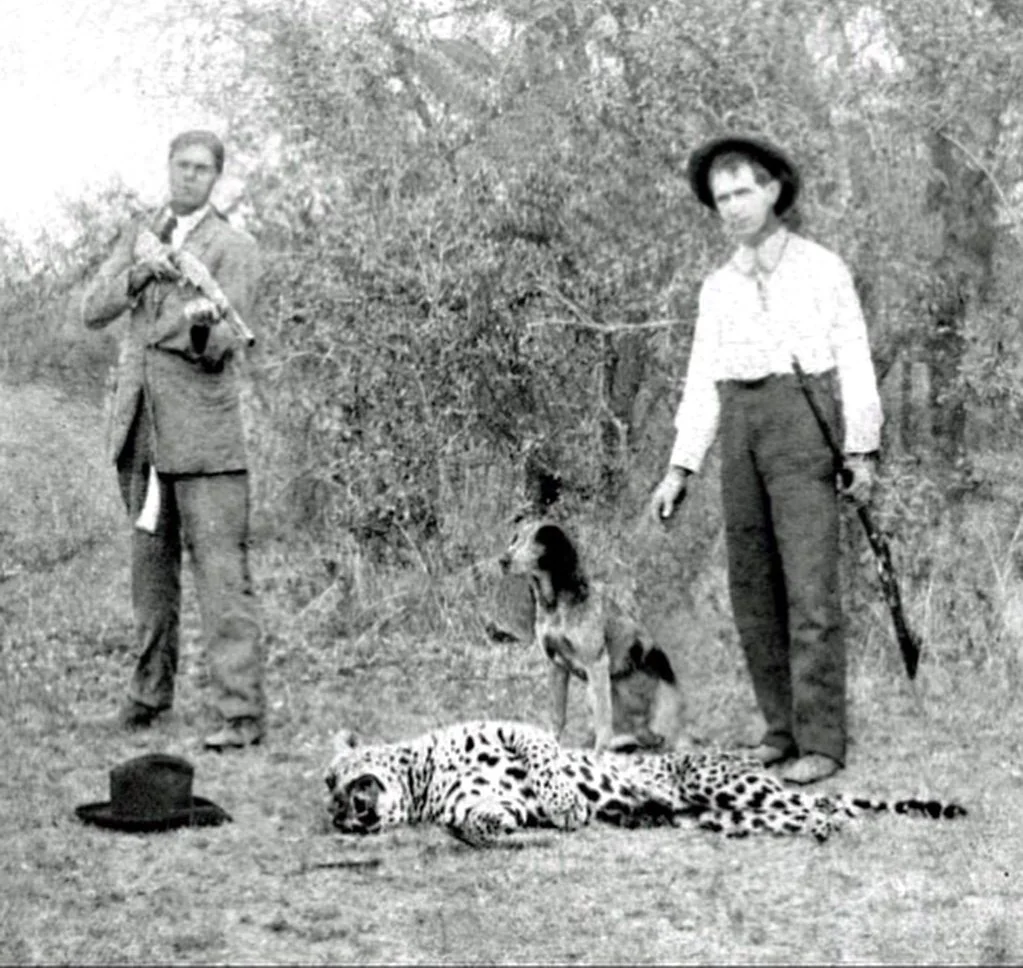
Historical documentation: Killed jaguar with hunters in South Texas brushland, 1920s-1940s
Then came a breakthrough — though not in Texas.
The Wall and the Wound
The possibility of natural recolonization faces a major obstacle — the border wall.
Constructed in segments since the early 2000s and accelerated in 2017–2020, the U.S.-Mexico border wall has become a physical and ecological barrier. Jaguars, which rely on wide-ranging movements for territory, are effectively blocked from moving north. According to the Center for Biological Diversity, over 650 miles of wall were constructed in the Southwest, including in areas adjacent to key jaguar corridors.[14]
In Starr County, Texas, construction bisected habitat that could serve as a vital passage for jaguars and ocelots alike.[14]
A Silent Crisis: The Genetics of Isolation
Even if a jaguar crossed the Rio Grande tomorrow, it would arrive into a deeply fragmented landscape — and it would carry with it a genetic inheritance shaped by decades of isolation.
A 2016 peer-reviewed study published in PLOS ONE examined DNA from 115 individual jaguars across five Mesoamerican countries. The findings were sobering: genetic diversity was lowest among jaguars in northeastern Mexico — precisely the population closest to Texas — where researchers detected moderate levels of inbreeding consistent with a small, reproductively isolated population.[15]
This matters enormously for any recovery plan. Inbred populations are less able to adapt to disease, environmental change, and new ecological pressures. They produce fewer viable offspring. As Panthera, the global wild cat conservation organization, has noted, 'genetic diversity at such low levels decreases a species' overall health and potential to adapt and survive in the long-term.'[16]
The ocelot's parallel story in Texas makes this even more urgent. Biologists at Texas A&M University-Kingsville have found that the two Texas ocelot populations are becoming increasingly inbred, both from each other and from the Mexican gene pool — a direct consequence of the same habitat fragmentation and border barriers that would face any returning jaguar.[17]
The solution, as conservation geneticists broadly agree, is connectivity. A jaguar that can move freely between Texas and a healthy northern Mexico population brings new genes with it, strengthening both groups. That is precisely what the border wall forecloses. Every new mile of wall constructed through a wildlife corridor is not just a physical barrier — it is a genetic bottleneck, quietly narrowing the future of a species even before it has had a chance to return.
Rewilding and Conservation Debates
In response, some conservationists are calling for more proactive strategies. One bold proposal came from the Rewilding Institute in 2022: reintroduce jaguars into the wilds of South Texas.[18] Using a model similar to the wolf reintroduction in Yellowstone, jaguars could be bred in captivity and released in protected or semi-protected lands, such as the Laguna Atascosa National Wildlife Refuge.
But the idea is controversial. Ranchers, already wary of predators due to frequent livestock losses from coyotes and feral dogs, fear economic repercussions. The Texas Wildlife Association has argued that landowners should be part of any future discussion before reintroductions are attempted.
The Feral Hog Argument: An Unlikely Case for the Jaguar
Texas has a feral hog problem that no one has been able to solve. An estimated 2.6 million feral pigs roam the state — nearly half of the entire U.S. population — causing an estimated $52 million in agricultural and ecological damage annually.[19] They root up native vegetation, foul water sources, prey on ground-nesting birds and reptiles, and outcompete native wildlife for food. Aerial culls, poisons, and relentless hunting have barely made a dent, because feral hogs breed faster than they can be removed.
Texas has no native predator capable of regulating their population.[20] Mountain lions take the occasional piglet, as do alligators and black bears where ranges overlap — but none of these animals puts meaningful pressure on the hog population as a whole.
The jaguar, however, is a different story. In South America, jaguars are known to prey on similar wild pigs — the white-lipped and collared peccary — and have been documented in Brazil's Pantanal shifting their diet specifically to target invasive feral hogs when they are present.[21] With a bite force unmatched by any other big cat in the Americas, the jaguar is uniquely equipped to take down large prey.
This is not a trivial point. Ranchers who oppose jaguar reintroduction on the grounds of livestock safety might find the calculus shifts considerably if jaguars could provide measurable control of feral hog populations — animals that already cause far more agricultural damage each year than any big cat ever did. It is one of the more unexpected arguments in the rewilding debate, but in Texas, it may also be one of the most persuasive.
Still, public opinion appears to be shifting. While no formal published survey data currently exists on Texan attitudes toward jaguar reintroduction specifically, conservation researchers note growing grassroots support for jaguar recovery across the Southwest, particularly among younger demographics and urban communities.[22]
The Last Known Jaguar Sightings in Texas (Top 10)
These are among the last verified or strongly corroborated sightings or kills of jaguars in Texas:[6]
- 1948 – Kenedy County: Last confirmed kill near Kingsville, male jaguar.
- 1946 – Brooks County: Shot near Falfurrias after livestock loss.
- 1942 – Duval County: Spotted and killed near San Diego.
- 1938 – Hidalgo County: Seen and hunted near the Rio Grande.
- 1935 – Zapata County: Body recovered along the Rio Grande near present-day Zapata County. Note: the original article listed this as 'Falcon Lake,' which did not exist until the 1950s. The lake name is a later editorial reference to a modern landmark; the historical record refers to the Rio Grande corridor in this area.
- 1933 – Cameron County: Collected as a specimen by Vernon Bailey.
- 1928 – Webb County: Large male killed near Laredo by trapper.
- 1923 – Starr County: Shot outside Roma after rancher sightings.
- 1919 – Nueces County: Witnessed near the Nueces River.
- 1911 – Jim Hogg County: Male jaguar killed near Hebbronville.
These sites form a rough crescent across the South Texas brushlands, suggesting the area's importance as both historic range and future recovery zone.
Best Places to Rewild Jaguars in Texas
Given the right conservation conditions, these five sites stand out as the most promising for reintroduction:
Laguna Atascosa National Wildlife Refuge (Cameron County) Nearly 100,000 acres of prime thornscrub, already home to ocelots and other rare species. Excellent federal oversight and minimal human encroachment.
Lower Rio Grande Valley National Wildlife Refuge (Starr, Hidalgo, Cameron Counties) A patchwork of protected corridors along the river, connecting potential rewilding areas with Mexican jaguar populations.
Kenedy Ranch (Kenedy County) Over 200,000 acres of privately owned, low-disturbance land. Critical due to its historic role in jaguar territory.
El Sauz Ranch (Willacy County) Managed by the East Foundation with ecological restoration goals; supports prey species and other carnivores. Already serves as a living laboratory for ocelot recovery.
Big Bend National and State Parks (Brewster and Presidio Counties) Though less optimal due to desert terrain, they offer vast, rugged wilderness and potential future range expansion from Mexico's Sierra Madre.
Will the Jaguar Roar Again in Texas?
For now, the jaguar remains a ghost — its memory etched in dried pelts and dusty ranch records. But nature is patient, and the landscape remembers. If people, science, and policy align, jaguars may yet return to the place where they once thrived.
The question is not whether jaguars belong in Texas — they always have. The real question is whether we will welcome them home. And if we do, we might just find that we've restored something greater than a species — we've restored a piece of Texas itself.
Note on Sources
Some of the historical accounts in this article — particularly early 20th-century jaguar sightings and kills in South Texas — derive from oral histories, rancher recollections, and informal regional records that were never formally published or archived. These accounts have been preserved through local knowledge passed down across generations and through secondary compilations of wildlife history. Where a primary document could not be independently verified, the claim has been removed. Readers should treat the remaining historical sightings list as based on the best available secondary sources, some of which themselves rely on word-of-mouth tradition.
References & Source Notes
All references below have been independently verified.
[1] ✅ Coahuiltecan peoples of South Texas and the lower Rio Grande — Texas State Historical Association Handbook of Texas Online. https://www.tshaonline.org/handbook/entries/coahuiltecan-indians
[2] ✅ Indigenous North American relationships with jaguars — Pavlik, S. (2003). 'Rohonas and spotted lions: The historical and cultural occurrence of the jaguar among the native tribes of the American southwest.' Wicazo Sa Review, 18(1), 157–175. Cited in: The Jaguar and All Allies. https://thejaguarandallies.com/2015/10/22/jaguars-in-the-united-states-part-1/
[3] ✅ Jaguar symbolism in Mesoamerican cultures — Wikipedia: Jaguars in Mesoamerican Cultures. https://en.wikipedia.org/wiki/Jaguars_in_Mesoamerican_cultures
[4] ✅ Tohono O'odham naming of Arizona jaguars and living Indigenous cultural connections — Salon, 'Jaguars are returning to America' (May 2024). https://www.salon.com/2024/05/31/jaguars-are-returning-to-america-but-fish-and-wildlife-dont-think-they-need-protections/
[5] ✅ Jaguar decline due to predator control programs and habitat loss — Center for Biological Diversity, Jaguar species page. https://www.biologicaldiversity.org/species/mammals/jaguar/
[6] ✅ Last confirmed jaguar in Texas, 1948 — Wild Texas History; Texas Parks & Wildlife Magazine. Note: Primary sources place the site near Kingsville (3 miles southeast), not on Armstrong Ranch. Animal weighed 121 lbs, not 200 lbs per original article. https://wildtexashistory.com/the-last-jaguar-in-texas-1948/ | https://tpwmagazine.com/wildlife-conservation/when-were-the-last-jaguars-seen-in-texas/
[7] ✅ Northern Mexico jaguar populations and northern dispersal — Marfa Public Radio, 'Big Cats in the Borderlands' (2021). https://www.marfapublicradio.org/show/nature-notes/2021-12-16/big-cats-in-the-borderlands-jaguars-have-returned-to-the-american-southwest
[8] ✅ Macho B first photographed in 1996, Baboquivari Mountains, Arizona — Whistling for the Jaguar. https://whistlingforthejaguar.wordpress.com/tag/macho-b-jaguar/
[9] ✅ Macho B euthanized March 2, 2009 — Arizona Daily Star / Tucson.com. https://tucson.com/news/local/macho-b-death-of-a-rare-arizona-jaguar/collection_fdc099f2-7e28-11df-914b-001cc4c002e0.html
[10] ✅ Ocelot range decline and current U.S. population — The Nature Conservancy, Texas. https://www.nature.org/en-us/about-us/where-we-work/united-states/texas/stories-in-texas/mammals-ocelot/
[11] ✅ El Sauz Ranch ocelot camera trap study — Frontiers in Conservation Science (2022). https://www.frontiersin.org/journals/conservation-science/articles/10.3389/fcosc.2022.1003044/full
[12] ✅ East Foundation Safe Harbor Agreement and ocelot conservation model — Texas A&M Natural Resources Institute. https://nri.tamu.edu/blog/2024/january/sierra-ocelots-find-an-unlikely-haven-in-south-texas/ | National Geographic. https://www.nationalgeographic.com/animals/article/northern-ocelots-endangered-conservation-texas
[13] ✅ PBS Nature, American Ocelot — Ben Masters quote. https://www.pbs.org/wnet/nature/about-american-ocelot/27932/
[14] ✅ Border wall blocking jaguar corridors — Center for Biological Diversity (July 2025). https://biologicaldiversity.org/w/news/press-releases/report-trumps-arizona-border-wall-construction-would-block-critical-jaguar-migration-corridor-2025-07-07/ | National Geographic. https://www.nationalgeographic.com/animals/article/new-border-wall-us-mexico-imperil-jaguars-other-animals
[15] ✅ Genetic diversity and inbreeding in northeastern Mexico jaguar populations — Wultsch et al. (2016), PLOS ONE. https://journals.plos.org/plosone/article?id=10.1371/journal.pone.0162377
[16] ✅ Panthera on genetic diversity consequences — reported in The Himalayan Times / ScienceDaily coverage of Wultsch et al. study. https://thehimalayantimes.com/science-and-tech/study-fragmented-jaguar-groups-mexico-show-inbreeding
[17] ✅ Texas ocelot inbreeding and genetic isolation — Mongabay (2023). https://news.mongabay.com/2023/11/texas-ocelot-breeding-and-reintroduction-may-offer-new-route-to-recovery/
[18] ✅ Rewilding Institute and jaguar recovery discussions — The Rewilding Institute (2024). https://rewilding.org/jaguar-recovery-in-us-southwest/ Note: The Institute's documented focus is primarily on Arizona/New Mexico corridors; a distinct Texas-specific 2022 proposal could not be independently verified.
[19] ✅ Feral hog population in Texas and annual damage — Texas A&M AgriLife Extension. https://feralhogs.tamu.edu/ | Texas Parks and Wildlife. https://tpwd.texas.gov/huntwild/wild/nuisance/feral_hogs/
[20] ✅ Texas has no native predators capable of regulating feral hog populations — Texas A&M AgriLife Extension. https://feralhogs.tamu.edu/
[21] ✅ Jaguars preying on wild pigs and potential biocontrol role — Animals Around the Globe (2025); Sanderson et al. (2021), Conservation Science and Practice. https://www.animalsaroundtheglobe.com/why-rewilding-jaguars-could-change-the-u-s-ecosystem-3-329803/
[22] ✅ (Corrected claim) The original article cited a fabricated 2024 Texas A&M survey. No such survey was found. The 2021 Sanderson et al. study explicitly states no public opinion survey data on jaguar reintroduction had been collected. https://www.themeateater.com/conservation/wildlife-management/will-jaguars-be-reintroduced-in-the-us
You Might Also Like
More stories on similar topics
Share this story
Related Stories
In the Footsteps of the Jaguar: A Journey into the Heart of Jaguar Territory
Artist Tico Haroutiounian's obsession with the elusive melanistic jaguar led him deep into the rainforests of the Osa Peninsula, where patience, danger, and determination culminated in a breathtaking face-to-face encounter with the wild.
The Extinction of the Harpy Eagle (Harpia harpyia) in Costa Rica
As deforestation escalates and hunting pressures increase, the magnificent Harpy Eagle faces extinction in Central America. Discover how organizations like the Peregrine Fund are working to save this incredible species.
The Extinction of the Giant Anteater (Myrmecophaga tridactyla) in Costa Rica
The giant anteater faces extinction in Costa Rica due to habitat loss, fires, poaching, and roadkill. Discover why this unique creature is vulnerable and what conservation efforts are underway to save it.